
Heating & radiators
Cold rooms are usually a system problem,not a boiler problem
- Power flush
- From £450
- Typical job
- Half day to two days
- Includes
- Filter and inhibitor
Diagnose it yourself
What your radiators are trying to tell you
| What you notice | What it usually means | What fixes it |
|---|---|---|
| Cold at the bottom, hot at the top | Magnetite sludge settled in the bottom of the radiator | Power flush plus a magnetic filter and fresh inhibitor |
| Cold at the top, hot at the bottom | Trapped air, often after the system has been drained or topped up | Bleed the radiators and re-pressurise — usually a five-minute job |
| Far radiators never get hot | System out of balance; the near radiators take all the flow | Balance the system on the lockshield valves, room by room |
| One radiator stone cold, others fine | Seized thermostatic valve pin, or a closed lockshield | Free or replace the valve — cheap and quick |
| Kettling or banging from the boiler | Scale and sludge on the heat exchanger causing localised boiling | Chemical clean or power flush before it damages the exchanger |
| Rooms warm slowly, bills climbing | Undersized radiators for the heat loss, or flow temperature set wrong | Room-by-room heat loss calculation and radiator upsizing |
Radiator sizing calculator
How much heat does that room actually need?
Heat output needed
5,200BTU/hr
1,500 watts · 33.6m³ room
Suggested radiator
One Type 22 radiator around 600 × 1000mm
- Figures assume a ΔT of 50°C. Run your system at a lower flow temperature for efficiency and you will need a physically larger radiator for the same output.
- Add roughly 10% if the room has a large patio door, or if it sits above an unheated garage or passage.
- Whole-house jobs deserve a proper room-by-room heat loss calculation. We do that free as part of any heating quote.
Power flushing
What it is, and when it is actually worth doing
What is actually happening in there
Steel radiators and water make magnetite — a black iron oxide sludge. It settles in the bottom of radiators, collects in the pump and coats the boiler's heat exchanger. It is why old systems get slower, noisier and more expensive to run every year.
How a power flush works
We connect a high-flow, low-pressure pump to the system and drive cleaning chemicals through it, reversing the flow radiator by radiator to lift the deposits and carry them out. It typically takes most of a day on a normal house.
When it is worth the money
Radiators cold at the bottom, a boiler that kettles, repeated pump failures, black water when you bleed, or before fitting a new boiler onto an old system. In those cases it is money well spent.
When it is not
If your radiators just need bleeding, or the system is genuinely clean and only needs balancing, we will tell you that and charge you for the smaller job. A flush on a clean system achieves nothing.
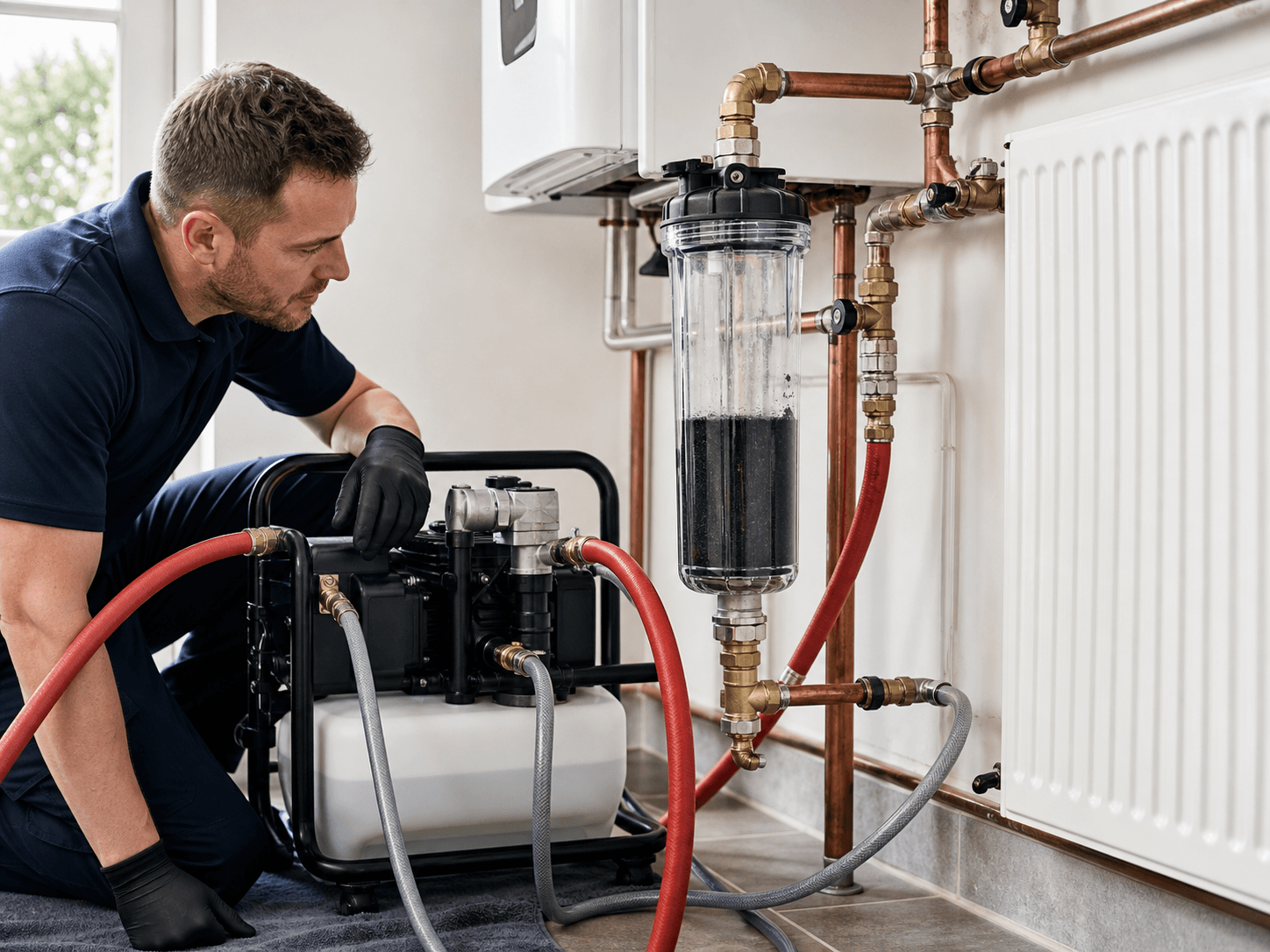
Always finished the same way
A flush without a filter and inhibitor is half a job — the sludge simply starts forming again. Every flush we do finishes with a magnetic filter fitted on the return and the system dosed with corrosion inhibitor. We test the inhibitor level at every subsequent service, because it depletes.
While we are there: flow temperature
Most combi boilers leave the factory set at 75–80°C and are never touched again. Dropping the heating flow temperature to around 60°C lets the boiler condense properly, which is where its efficiency actually comes from. On a well-balanced system you get the same comfort for noticeably less gas. It costs nothing and we will do it while we are there.
Also on this list
The rest of the heating work we do
Radiator replacement
Upgrades, relocations, designer and vertical radiators where wall space is tight, and towel rails in bathrooms.
System balancing
Setting every lockshield so each radiator gets its share of the flow. Unglamorous, and it fixes more cold rooms than anything else.
Smart thermostats
Hive, Nest, Tado and Honeywell supplied, fitted and actually set up properly — including the schedule.
Zoning and TRVs
Splitting upstairs and downstairs onto separate zones, or smart TRVs so you stop heating empty rooms.
Unvented cylinders
Mains-pressure hot water for properties where a combi cannot keep up. Installed and commissioned to G3.
Pumps and valves
Circulating pumps, motorised valves, wiring centres and programmers — the parts that quietly fail and stop everything.
Straight answers
Heating questions
My radiators are cold at the bottom — what does that mean?
Why does my boiler keep losing pressure?
What size boiler do I need?
Do you charge for a quotation?
Often needed together
You might also want a look at
Boiler Installation & Replacement
A properly sized boiler, fitted tidily in a day, with the warranty registered before we leave.
Read moreAnnual Boiler Servicing
The yearly check that keeps your warranty valid, your bills sensible and your family safe.
Read moreEmergency Plumbing & Leaks
Burst pipe, leak or blockage? Talk to an engineer now and we will talk you through making it safe.
Read more
Get every room warm again
We will diagnose what is actually wrong before recommending anything. Ring 07973 665324 or book a survey online.