
Emergency plumbing
Water where it should not be?
First job is stopping it. Second job is us. Scroll down for the make-safe steps for your exact situation — or ring now and we will talk you through it on the phone.
Find your stopcock
Under the kitchen sink, in a downstairs cloakroom, or near the front door. Clockwise to close.
Then the electrics
Water near sockets, lights or the consumer unit? Main switch off and stay clear.
Make it safe first
What is happening right now?
Burst pipe or major leak
Stop the water, then protect the electrics
- 1
Turn off the internal stopcock
Usually under the kitchen sink, in a downstairs cloakroom, or near the front door. Turn it clockwise until it stops.
- 2
Open all the cold taps
This drains the pipework down and takes the pressure off the leak.
- 3
Turn the heating off
Switch the boiler off at the fused spur. Do not let it fire with the system draining.
- 4
Kill the power if water is near it
If water is anywhere near lights, sockets or the consumer unit, turn the electricity off at the main switch and stay clear.
- 5
Contain what you can
Buckets and towels. Lift what you can off the floor. Photograph everything for your insurer before you clear up.
Made it safe? Now get an engineer to it.
You will speak to someone who does this for a living, not a call handler reading a script.
Leak detection
Finding it without taking your floor up
Pressure testing
Isolate sections of pipework and pressurise them one at a time. It tells us which run the leak is on before we open anything.
Thermal imaging
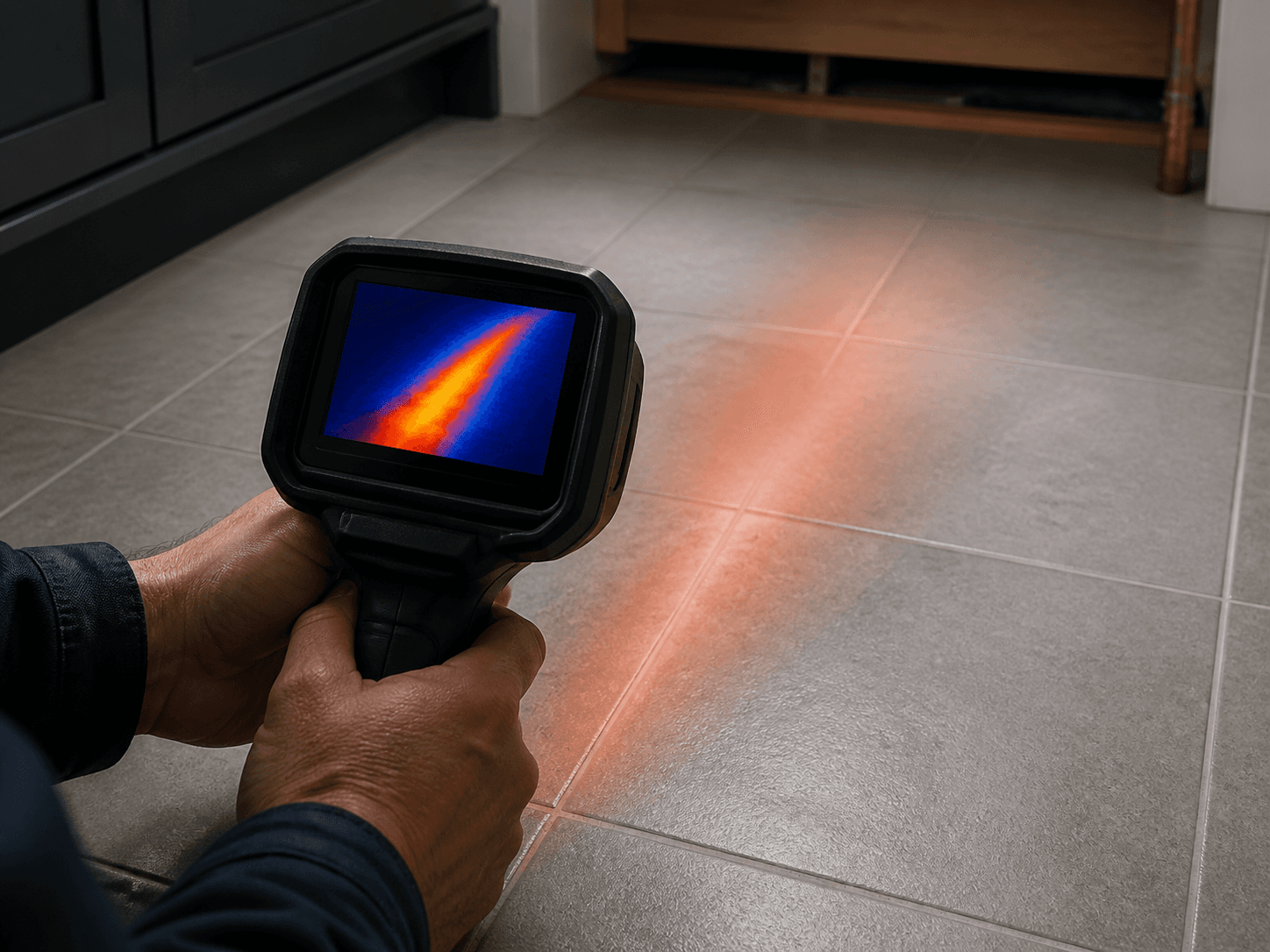
A warm heating leak under a floor shows up as a clear plume on a thermal camera — often pinpointing it to within a few centimetres.
Acoustic listening
Pressurised water escaping makes a very specific noise. Ground microphones pick it up through screed and concrete.
Sometimes, re-routing beats chasing
Where a leak sits under a solid floor, running a new pipe by another route is often cheaper and far less disruptive than excavating. We will tell you when that is the sensible call.
A note about your insurance
Most home insurance policies cover “trace and access” — the cost of finding a leak and repairing the damage caused getting to it — even where they do not cover the failed pipe itself. Photograph everything before you clear up, keep our invoice, and ring your insurer before you commit to major making-good. We are happy to write up what we found in a form they will accept.
What counts as an emergency
If in doubt, ring. We would rather talk you down than turn up late.
- Burst pipes and mains leaks
- Leaks through a ceiling or into a light fitting
- No water at all in the property
- Blocked or overflowing toilets, especially in a one-bathroom home
- Blocked drains backing up into the house
- Hot water cylinder or immersion failures
- Leaking radiator valves and towel rails
- Failed stopcocks that will not shut off
- Frozen or split pipes in cold weather
- Washing machine and dishwasher supply leaks
- Outside taps and pipework split by frost
- No heat or hot water in a vulnerable household
How we price emergency work
You get a price before we set off, not after we arrive. Emergency call-outs start at £95 including the first hour on site, with parts quoted separately once we can see what has failed. Nobody wants a negotiation while their kitchen ceiling is coming down.
Straight answers
Emergency questions
What should I do first if a pipe bursts?
Can you find a leak without ripping up the floor?
Why is my water pressure so poor?
How quickly can you come out?
Do you charge for a quotation?
Often needed together
You might also want a look at
Central Heating & Radiators
Cold spots, noisy pipes and rooms that never warm up — usually a system problem, not a boiler one.
Read moreBoiler Repairs & Fault Finding
No heating or hot water? We diagnose properly, quote before we fix, and carry the common parts.
Read moreBathroom Installation & Refurbishment
Full bathroom fits managed end to end — one team, one schedule, one point of contact.
Read more
Made it safe? Now get it fixed.
Ring 07973 665324 for anything urgent — it is always faster than a form. For non-urgent plumbing, book online and pick your slot.